


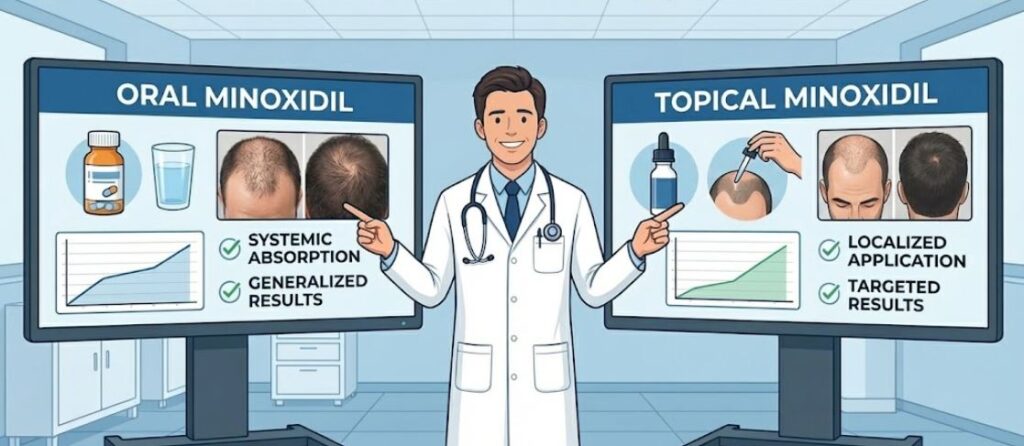
- Oral Minoxidil works from within to stimulate hair growth systemically, often showing faster efficacy than traditional external applications.
- Topical Minoxidil targets the scalp directly, concentrating the treatment on specific thinning areas while minimizing systemic absorption.
- Pills offer superior convenience compared to messy foams or serums, simplifying your daily routine without compromising results.
- Your doctor tailors the choice based on your specific medical history, ensuring you receive the safest, most effective path to regrowth.
Navigating the options for hair loss treatments can feel overwhelming. This is particularly true when choosing between oral medications and topical applications. We understand that effectively targeting Androgenetic Alopecia (male pattern hair loss) requires a solution that is both potent and compatible with your daily routine. As the medical team at Aneeq, working closely with our Medical Director Dr. Hassan Galadari, we are dedicated to clearing up this confusion with expertise and empathy.
You need clarity rather than complexity. This guide directly compares oral vs topical minoxidil results using verified medical data. We demonstrate how these dermatology treatments differ in efficacy. We aim to empower you with the trustworthy knowledge necessary to make an informed decision about your health.
Understanding how minoxidil works for hair loss
Minoxidil acts as a vasodilator. This means it widens blood vessels to optimize circulation. This increased blood flow delivers oxygen and essential nutrients directly to your follicles. For men facing androgenetic alopecia, this targeted nutrient boost is critical for restarting development.
The medication works by prolonging the anagen (growth) phase of the hair cycle. This process effectively reverses the miniaturization caused by genetic hair loss. It converts thin vellus strands back into robust and pigmented terminal hair. Restoring this healthy terminal hair is the core objective of our medical hair loss treatments.
The delivery method defines the experience. Topical minoxidil absorbs through the scalp to target roots locally. Conversely, oral minoxidil works systemically after ingestion. While originally designed to manage high blood pressure, low-dose oral minoxidil is highly effective for regrowth. Whether you use the topical solution or the pill, both options fight hair loss by encouraging the return of thick terminal hair.
Comparing efficacy: does oral minoxidil yield better results?
For men navigating the complexities of Androgenetic Alopecia, the choice between swallowing a pill and applying a solution is not just about convenience. It is about results. While topical minoxidil has been the standard first-line defense for decades, recent clinical data suggests that Oral Minoxidil may offer distinct advantages for specific patients. At Aneeq, our DHA-licensed doctors review these findings carefully to ensure your treatment plan is backed by science.
A pivotal clinical trial published in JAMA Dermatology by Paulo Müller Ramos and colleagues has provided crucial insight into this debate. The study specifically compared the efficacy of low-dose Oral Minoxidil against the standard 5% topical solution. The primary metric for success was the change in terminal hair count. This refers to the thick and pigmented strands that provide visible scalp coverage (as opposed to thin vellus hair). Using precise photographic assessment, the researchers tracked the total hair count and hair density over a period of 24 weeks.
The results highlighted a significant difference in favor of the systemic treatment. Patients treated with Oral Minoxidil demonstrated a superior increase in terminal hair density at the vertex (crown) compared to those using the topical version. Specifically, the oral medication was more effective at converting miniaturized follicles back into robust terminal hair. Renowned dermatologist Rodney Sinclair has also championed the use of oral minoxidil. He noted its ability to improve hair retention in patients who did not respond well to topical applications.
Advanced analysis tools corroborate these findings. They show that while topical minoxidil improves hair density from baseline, Oral Minoxidil often yields a higher total count of terminal hair. This is particularly relevant for the frontal scalp, where regrowth is notoriously difficult. For men suffering from Androgenetic Alopecia, the goal is maximizing the number of strong strands. The oral pill achieves this by ensuring the active medication reaches the hair follicle systematically. This removes the variable of absorption rates common with creams or foams.
However, efficacy is not the only factor. Adherence matters. Missing applications of topical minoxidil can stall progress. The ease of taking a pill often leads to better compliance and better preservation of hair. Whether you choose oral or topical treatment, consistency remains the key to maintaining your results.
| Study/Source | Oral Dosage | Topical Concentration | Results (Terminal Hair Density/Count) |
|---|---|---|---|
| JAMA Dermatology (Ramos et al.) | 1 mg daily | 5% solution | Oral Minoxidil showed superior increase in terminal hair at the vertex. |
| Rodney Sinclair (Review) | Low-dose (variable) | N/A (Monotherapy) | High efficacy in increasing total hair counts for Androgenetic Alopecia. |
Safety profile: side effects of oral vs topical application
When deciding between Oral and Topical Minoxidil, understanding the safety profile is essential for your peace of mind. While both formulations are effective for hair restoration, their different delivery methods create distinct potential adverse effects. Because topical minoxidil is applied directly to the scalp, its absorption into the bloodstream is minimal. This means side effects are largely confined to the skin. Users may experience local irritation, redness, or dermatitis at the application site. Although the topical form is the formulation with direct FDA approval for treating hair loss, some men find the daily application messy or irritating.
In contrast, Oral Minoxidil works systemically. It circulates throughout your body to reach the hair follicles. This systemic action increases the likelihood of generalized side effects. These can include a headache, slight fluid retention, or dizziness due to lower blood pressure. However, the most distinct difference in safety profiles involves Hypertrichosis. This is defined as excessive hair growth in unwanted areas (such as the forehead, arms, or back).
Because the medication circulates internally, the risk of Hypertrichosis is significantly higher with the oral pill than with the topical solution. While Hypertrichosis is generally cosmetic and reversible, it is a key factor our doctors monitor. It is also important to note that both forms can cause temporary shedding. This phase is clinically known as Telogen Effluvium and indicates the treatment is working to restart the growth cycle.
Our medical team helps you navigate these risks by personalizing your plan. Topical Minoxidil is often recommended if you want to avoid systemic issues. Oral Minoxidil is prescribed at low and controlled dosages to minimize the risk of Hypertrichosis while maximizing convenience. If signs of excess hair growth or dermatitis appear, your doctor can adjust your dosage immediately. Strict medical supervision ensures that any side effect is managed safely and effectively.
Convenience and daily compliance
Treating Androgenetic Alopecia effectively requires absolute consistency. While Topical Minoxidil works, it demands a strict daily routine. Whether you use a liquid solution or a foam, applying it twice a day can be messy and often interferes with styling. The hassle of sticky residue can make it difficult to maintain usage long-term. Unfortunately, skipping applications compromises your results.
In contrast, Oral Minoxidil removes this friction entirely. Taking a pill is discreet and far simpler than a specialized scalp regimen. This ease of use significantly boosts compliance and ensures you never miss a dose. Because steady medication levels are vital for halting hair loss, this simplicity often leads to better outcomes. If you prefer this streamlined approach, our doctors can assess you for a personalized oral minoxidil and finasteride plan.
Which treatment is right for you?
Deciding on the best path to tackle Androgenetic Alopecia depends entirely on your specific hair profile. Topical Minoxidil is often the recommended starting point for men targeting early-stage hair loss directly at the root. However, if you find daily application cumbersome or require a stronger approach, Oral Minoxidil serves as a powerful alternative.
This systemic option addresses hair loss from within. It is typically prescribed as a low-dose daily tablet (often up to 5 mg). While the topical form works locally, the oral form supports widespread regrowth. We utilize the Norwood-Hamilton scale to gauge severity and ensure safety. Our Medical Director, Dr. Hassan Galadari, ensures your personalized treatment plan is medically sound. In clinical settings, participants using oral medication often report better adherence. Ultimately, the final choice always relies on a doctor’s careful assessment.
Our medical team’s verdict on minoxidil treatments
At Aneeq, our DHA-licensed medical team confirms that there is no “one-size-fits-all” solution. Both oral and topical minoxidil demonstrate high efficacy in restoring density and promoting Terminal Hair growth. However, the most effective path depends entirely on your medical profile and lifestyle preferences.
We provide a safe space to explore these options with confidence. Complete your free online assessment today. A doctor will review your needs during a secure consultation to prescribe the personalized treatment intended just for you.
Frequently asked questions
How does the hair growth efficacy of oral minoxidil compare to the standard 5% topical solution?
When fighting Androgenetic Alopecia, efficacy often depends on absorption. Some men lack the specific scalp enzyme needed to activate Topical Minoxidil effectively. For these patients, Oral Minoxidil is often more effective at generating thick Terminal Hair. While the standard 5% topical solution works well for many men, the oral form ensures the medication reaches the follicles through the bloodstream. This bypasses scalp absorption barriers that can limit results in some resistant cases.
What are the distinct side effect profiles of systemic (oral) versus local (topical) minoxidil?
The treatment route dictates the side effects. Generally, topical minoxidil stays on the skin. Adverse reactions are usually local issues like itching or dryness. Conversely, oral medication is systemic. This means it circulates throughout the body. While highly effective, this systemic reach can rarely cause broader effects like lower blood pressure or fluid retention. Our medical team carefully reviews your history to ensure your treatment plan remains safe and suitable for your lifestyle.
Does oral minoxidil significantly increase the risk of hypertrichosis (unwanted body or facial hair) compared to topical application?
Yes, Hypertrichosis (excessive hair growth) is a higher risk with Oral Minoxidil. Because the drug treats the condition systemically, it can inadvertently stimulate hair growth on the face or hands. With topical application, the risk of Hypertrichosis is unlikely unless the liquid accidentally drips onto other areas. While unwanted hair can occur, many men find mild Hypertrichosis to be a manageable trade-off for restoring their hairline density.
How long does it typically take to see visible results from oral minoxidil compared to the topical foam or liquid?
Reversing the effects of hair loss takes patience. With consistent use of Topical Minoxidil, visible changes typically appear in 4 to 6 months. Oral treatment can be slightly faster. It sometimes shows improvements within 3 months due to consistent dosing. Both methods aim to produce robust Terminal Hair over time. However, stopping treatment allows the hair loss process to resume.